8:13 AM
 Chiken Joe


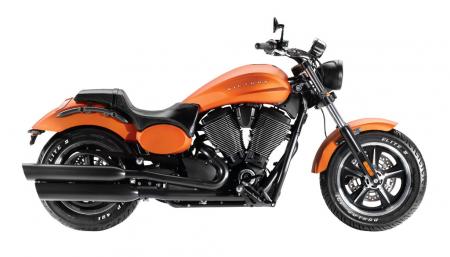
The first impression the Judge imposes is that it’s a power cruiser with a lineage from the Hammer S. Although this new bike is stout looking, just like the Hammer, the Judge is its own machine, with its classic American muscle car-inspired styling revealed most prominently in the cast-aluminum 5-spoke wheels wrapped in plump 16-inch Dunlop 491 tires wearing raised white lettering.
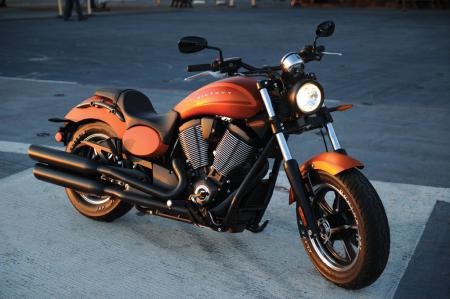
Lindaman also points out that the mid-mount foot controls’ location underwent a good deal of planning – rather than just getting yanked back – as evidence that the bike’s ergos are intended to accommodate riders in the range of 5-feet-and-some-change to well beyond the 6-foot mark.
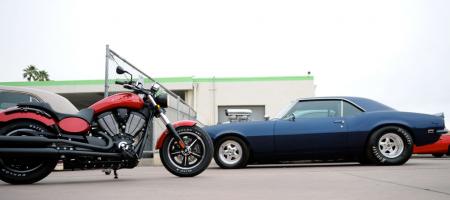
The forward-mounted one-piece handlebar requires some stretch – even a fellow test rider who stands in that 6-plus-feet range noted the reach. However, over the course of the day no one complained that the rider triangle was unbalanced due to the bar’s location.
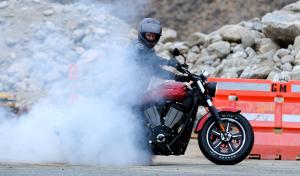
With Victory’s 106 cubic-inch Freedom V-Twin (with engine mapping similar to Victory’s other cruisers) as a power source, and a forward-leaning riding position complementing the Judge’s muscular styling, visions of one burnout after another danced in my head. And so I was compelled to dump the clutch, slam the throttle open and blitz ahead whenever the opportunity presented itself. The Judge didn’t disappoint me when I was less than judicious with the throttle: it sprinted quickly away from a stop as I rowed through the smooth-shifting 6-speed gearbox.
As spirited as the quick-revving 106 is, it also possesses plenty of torque (113 ft-lb claimed) to keep the Judge chugging effortlessly down the streets. The combination of the lower gears’ wide-feeling ratios and the big Twin’s healthy pulling power meant running in higher gears was often overkill on city surface streets where posted speeds are often below 45 mph.
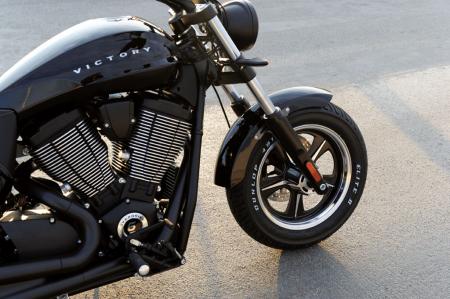
However, when conditions warranted shifting into higher gears the engine continued to flex its strength as it darted ahead with bursts of surprising acceleration, even when lumbering along at low rpm in 4th gear. We know the Judge’s engine isn’t more powerful than any other Victory, but in the Judge the Victory Twin simply feels like a more potent powerplant.
With a claimed dry weight of 660 pounds the Judge isn’t appreciably lighter than the Hammer 8-Ball or Hammer S (672 pounds dry). But Victory reps explained (without offering specific figures) that the Judge’s wheels are lighter than the Hammer S’s wheels, therefore giving the Judge an acceleration advantage by way of its wheels’ lower rotational mass and unsprung weight. Also lightening the Judge’s load is one less front brake caliper/rotor combo compared to the Hammer’s dual front calipers.
Despite using only one four-piston caliper with a 310mm disc in front, the solo brake reeled in the Judge with authority. Applying the front and rear brake (310mm disc, 2-piston caliper) simultaneously hauled in the Judge pronto, with nearly as much braking performance as I’ve experienced on various sport and standard-type motorcycles. I applaud Victory here for supplying the Judge with such excellent braking performance.
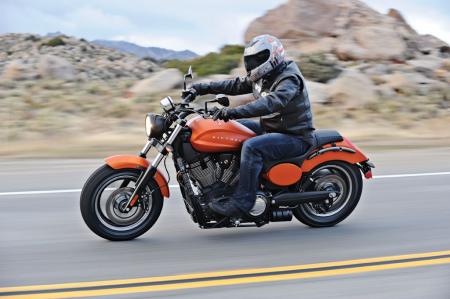
When we first learned in the Judge’s previewthat Victory broke from its own (as well as other manufacturers’) fat-rear-tire tradition by installing a 140mm rear tire on the Judge, I immediately anticipated a more compliant, lighter-steering cruiser. My suspicions the Judge would steer and handle better than a number of its brethren were confirmed the first time I shoved on the bar to dart into a left-hand turn lane. The Judge flicked quickly to the left and I shouted in my helmet, “Now this is how a cruiser should handle!”
My elation over the Judge’s handling grew as our test ride saw mile after mile of curving mountain roads where the new Vic cruiser continued to impress with its low-effort steering and noteworthy stability. From corner entry to corner exit the Judge stayed predictably on track.
Since the Judge is a low-ish riding cruiser it of course will eventually drag footpegs when cornering, especially if you’re purposely dashing between turns as quickly as you can. To the Judge’s credit, though, it had what felt like better than average lean-angle clearance.
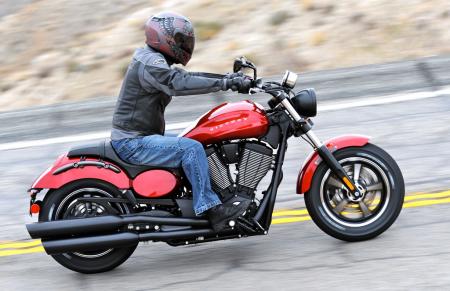
Adding some spring preload to the hidden shock’s ramp-style preload adjuster to increase ride height will improve lean angle clearance. However, if you’re really keen on railing the Judge, Victory offers an accessory shock with 1.0-inch more ride height than what the standard shock provides. On the subject of suspension, the Judge’s cartridge-type 43mm conventional fork with 5.1 inches of travel has no provision for tuning but it nevertheless gobbled up most road imperfections before they had a chance to upset the ride. Only the sharpest bumps and deep ruts in the road were able to overcome the fork’s otherwise good damping performance.
I had no serious issue with the Judge’s 16-inch tires (they worked well, with sufficient grip and feel), but I was compelled to ask Victory why it chose 16s rather than 17s that potentially could open up a wider selection of sportbike-type rubber. Lindaman said plainly that 16s were better suited to the style Victory wanted to achieve in the Judge, but he also explained that keeping the bike’s MSRP reasonably low was crucial as well.
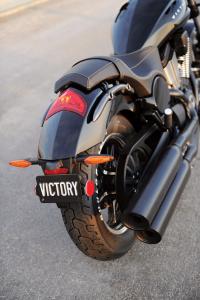
Using an off-the-shelf tire (that worked as needed) like the well-known Dunlop 491, rather than one designed specifically for the Judge, means less out of pocket for Victory, as well as for the consumer. It’s not uncommon for motorcycle manufacturers to have a tire maker design tires with particular traits and construction in order to purposely complement a bike’s handling. But a purpose-built original-equipment tire for a specific motorcycle is almost always more costly to replace when compared to an identical model tire made for a wide range of bikes.
Despite Victory’s claim that the Judge’s intended target audience earns income in the $65K range, the company nevertheless introduced its newest cruiser with a comparatively low $13,999 price tag for the Gloss Black color scheme, making the Judge the third lowest priced model in Victory’s 17-bike lineup.
In context of the competition, Victory sees Harley’s Fat Bob as its rival. The Fat Bob produces a claimed 100 ft-lbs compared to the Judge’s 113 ft-lbs, weighs a few pounds more, has a 1.0-inch taller seat height and cost about $1350 more than the Victory.
With the exceptions of the slightly long reach to the handlebar and somewhat cruiser-typical limited lean angle, I found very little to dislike in the new Judge. Objective data aside, these days I’ve come to value the fun factor metric as much as any criteria I use to evaluate a motorcycle. By that measure there are a few bikes that I simply enjoy for pure entertainment and look forward to riding again as soon as possible. For example, Triumph’s 675 Street Triple R or Ducati’s first gen Multistrada are endlessly entertaining to me.
When it was time to park the Judge for the day I was genuinely disappointed the sun had set. I’m eager to once again go to Victory’s court and see the Judge.
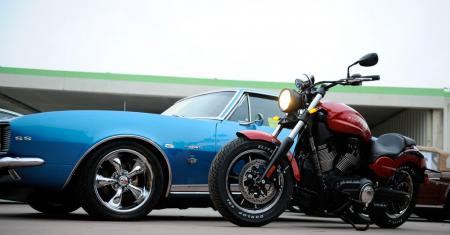
This is the first 2013 model in Vic’s stable, and it isn’t replacing any current models but is in addition to the rest of the Victory lineup for 2012. Expect to see the Judge in dealers by April, with its consumer debut during Daytona Bike Week 2012. The Suede Nuclear Sunset or Sunset Red colors will retail for $14,399.
Related Reading
2013 Victory Judge Preview
2012 Victory Hard-Ball Review
2012 Victory High-Ball Review
2011 Victory Lineup Reviews
2007 Power Cruisers Shootout